MRI scans and CT scans are two of the most commonly used diagnostic imaging tests. Both allow doctors to see inside the body without surgery, but they use different technologies and are often recommended for different medical conditions.
If your healthcare provider orders diagnostic imaging, you may wonder about the difference between an MRI and a CT scan, which test provides better images, how long each procedure takes, and whether one is safer than the other.
Understanding MRI vs. CT scan imaging can help you know what to expect before your appointment and why your doctor may recommend one test instead of another.
What Is an MRI?
MRI stands for magnetic resonance imaging. An MRI scan uses a powerful magnetic field and radio waves to create highly detailed images of structures inside the body.
MRI is particularly useful for examining soft tissues and areas where detailed contrast between different types of tissue is important.
Doctors commonly use MRI scans to evaluate:
- The brain and spinal cord
- Muscles and tendons
- Ligaments
- Joints
- Internal organs
- Blood vessels
- Soft tissue injuries
- Certain tumors and abnormalities
Unlike X-rays and CT scans, an MRI does not use ionizing radiation.
What Is a CT Scan?
CT stands for computed tomography. A CT scan uses X-rays and computer processing to produce detailed cross-sectional images of the body.
While a standard X-ray provides a two-dimensional image, a CT scan combines multiple X-ray images taken from different angles. This allows doctors to examine bones, organs, blood vessels, and other internal structures in greater detail.
CT scans are commonly used to evaluate:
- Bone fractures
- Internal injuries
- Lung conditions
- Abdominal problems
- Kidney stones
- Certain cancers
- Blood clots
- Internal bleeding
Because CT imaging is relatively fast, it is also frequently used when doctors need diagnostic information quickly.
MRI vs. CT Scan: What Is the Main Difference?
The biggest difference between an MRI and a CT scan is the technology each test uses.
An MRI uses magnets and radio waves to create images, while a CT scan uses X-rays.
The type of images they produce also differs. MRI scans generally provide more detailed images of soft tissues, while CT scans are often particularly effective for evaluating bones, lungs, internal bleeding, and certain emergency conditions.
The best imaging test depends on the area of the body being examined and the medical information your doctor needs.
Which Is Better: MRI or CT Scan?
Neither an MRI nor a CT scan is universally better. Each type of diagnostic imaging has specific advantages.
An MRI may be preferred when detailed images of soft tissues are needed. For example, an MRI can help physicians examine the brain, spinal cord, ligaments, tendons, muscles, and joints.
A CT scan may be preferred when doctors need to quickly examine bones, the lungs, internal organs, or possible internal injuries.
Your healthcare provider will choose the imaging study that is most appropriate for your symptoms, medical history, and suspected condition.
MRI vs. CT Scan for the Brain
Both MRI and CT scans can be used for brain imaging, but they may be ordered for different reasons.
A CT scan of the brain can be especially useful when doctors need rapid imaging, such as when evaluating certain injuries or possible bleeding.
A brain MRI can provide more detailed images of the brain’s soft tissues and may be recommended to investigate neurological symptoms or certain abnormalities.
The appropriate test depends on the patient’s symptoms and the clinical situation.
MRI vs. CT Scan for the Spine
MRI is frequently used to evaluate the spine because it provides detailed images of the spinal cord, discs, nerves, and surrounding soft tissues.
An MRI may help doctors investigate issues such as:
- Herniated discs
- Spinal cord abnormalities
- Nerve compression
- Ligament injuries
- Certain causes of persistent back pain
CT scans can also provide valuable information about the spine, particularly when detailed images of bone structures are needed.
MRI vs. CT Scan for Bones and Joints
CT scans provide highly detailed images of bones and can be useful for identifying certain fractures or complex bone injuries.
MRI scans are often useful when the concern involves structures surrounding the bone, including:
- Ligaments
- Tendons
- Cartilage
- Muscles
- Joint tissues
For example, a physician evaluating a knee injury may order an MRI when a ligament or cartilage injury is suspected.
Does an MRI or CT Scan Use Radiation?
One important difference between MRI and CT imaging is radiation exposure.
MRI does not use ionizing radiation. It uses a magnetic field and radio waves.
CT scans use X-rays, which involve ionizing radiation.
The amount of radiation from a CT scan varies based on the type of examination and area being imaged. Healthcare providers consider the benefits and potential risks when determining whether a CT scan is appropriate.
Which Takes Longer: MRI or CT Scan?
CT scans are generally faster than MRI scans.
Many CT scans can be completed within a relatively short period, although the total appointment time may vary depending on the exam and whether contrast is required.
An MRI often takes approximately 20 to 60 minutes, and some examinations may take longer.
MRI scans require patients to remain still for longer periods because movement can affect image quality.
What Does an MRI Machine Look Like?
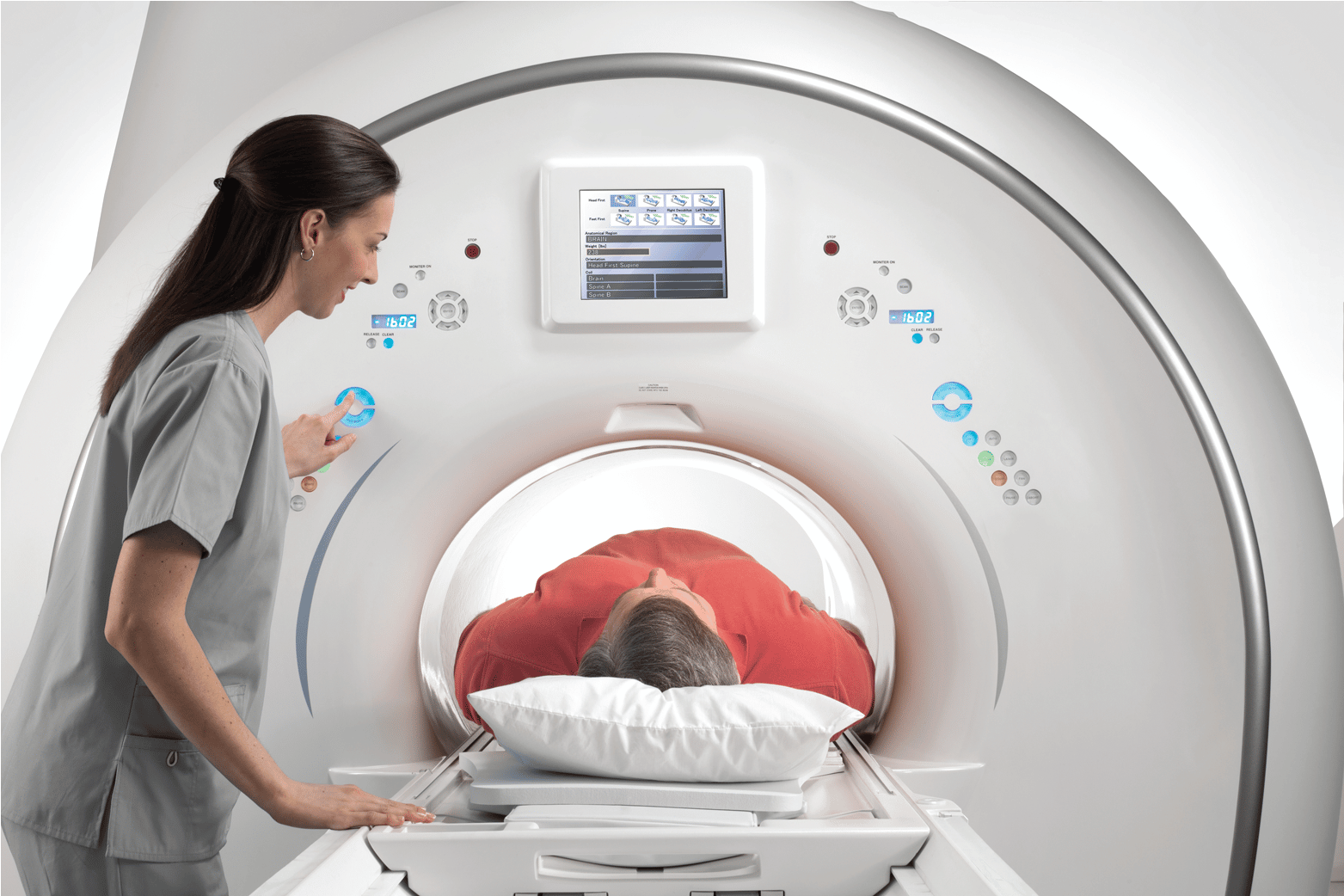
An MRI machine typically contains a large magnet with an opening in the center. During the exam, the patient lies on a table that moves into the scanner.
The machine produces loud knocking, tapping, and buzzing sounds while images are being taken.
Some patients may experience claustrophobia or anxiety during MRI imaging. If you are concerned about being inside the scanner, talk to your radiology center before your appointment.
What Is a CT Scan Like?
A CT scanner typically looks like a large ring or doughnut with an opening in the center.
The patient lies on a table that moves through the scanner while images are captured.
Because the CT scanner is relatively open and the imaging process is usually fast, patients often spend less time inside the scanning equipment than they would during an MRI.
MRI With Contrast vs. CT Scan With Contrast
Both MRI and CT imaging may sometimes be performed with contrast material.
Contrast helps certain tissues, blood vessels, organs, or abnormalities appear more clearly on diagnostic images.
MRI contrast and CT contrast are different types of substances. Depending on your medical history, your healthcare provider may ask about kidney function, allergies, previous reactions to contrast, and other health conditions before your exam.
Not every MRI or CT scan requires contrast.
Can You Have an MRI If You Have Metal in Your Body?
MRI uses a strong magnetic field, so patients must complete a safety screening before entering the scanner.
Tell the radiology team if you have:
- A pacemaker
- Cochlear implants
- Metal clips
- Joint replacements
- Metal plates or screws
- Neurostimulators
- Implanted pumps
- Metal fragments
- Other implanted medical devices
Having an implant does not automatically mean you cannot receive an MRI. Many modern devices are designed to be compatible with certain MRI environments, but the imaging team must verify this before your exam.
CT scans do not use a strong magnetic field, so they do not have the same type of metal-related restrictions.
MRI vs. CT Scan for Claustrophobia
Patients with claustrophobia may find an MRI more challenging because an MRI examination typically takes longer and requires spending more time inside the scanner.
CT scanners generally have a larger opening and scan more quickly.
If you experience claustrophobia, tell your imaging provider before your MRI appointment. The radiology team can explain what to expect and discuss available options for making the procedure more comfortable.
How Do You Prepare for an MRI?
MRI preparation varies depending on the type of scan.
Before your appointment, you may be asked to:
- Remove jewelry and metal objects
- Change into a medical gown
- Provide information about implants or medical devices
- Follow specific eating or drinking instructions
- Arrive early for safety screening
- Provide previous imaging records
Your radiology provider will give you specific instructions based on your examination.
How Do You Prepare for a CT Scan?
Preparation for a CT scan also depends on the area being examined and whether contrast will be used.
You may be asked to:
- Avoid eating for several hours before the scan
- Drink water before your appointment
- Remove certain jewelry or clothing
- Arrive early for paperwork or preparation
- Provide information about allergies or kidney conditions
- Drink oral contrast or receive contrast through an IV
Always follow the instructions provided by your diagnostic imaging center.
MRI vs. CT Scan: Which One Is Right for You?
The decision between an MRI and a CT scan is based on what your healthcare provider needs to evaluate.
An MRI may be recommended when detailed soft tissue imaging is important, particularly for the brain, spine, joints, muscles, ligaments, and certain organs.
A CT scan may be recommended when fast imaging is needed or when doctors need detailed views of bones, lungs, internal organs, or certain injuries.
In some cases, physicians may use multiple diagnostic imaging tests to obtain different types of information.
Frequently Asked Questions About MRI vs. CT Scans
Is an MRI safer than a CT scan?
MRI does not use ionizing radiation, while CT scans use X-rays. However, both tests are widely used diagnostic imaging procedures. The appropriate choice depends on your medical needs and individual circumstances.
Is an MRI more detailed than a CT scan?
MRI often provides greater detail for soft tissues. CT scans can provide excellent detail of bones, lungs, and many internal structures. The best test depends on what your doctor needs to examine.
Which is faster, an MRI or a CT scan?
CT scans are generally faster. MRI examinations often require more time because numerous detailed images are captured.
Can a CT scan detect things an MRI cannot?
Yes. CT scans and MRI scans visualize tissues differently, which means each can provide information that may be more useful for certain conditions.
Why would a doctor order an MRI after a CT scan?
Sometimes a doctor may order an MRI after a CT scan when additional detail is needed, particularly for soft tissues or a specific area identified during the first examination.
MRI and CT Scan Services in El Paso, TX
Choosing between an MRI and a CT scan is not something patients usually need to determine on their own. Your healthcare provider will recommend the diagnostic imaging test that best matches your symptoms and medical needs.
Professional Radiology provides MRI and CT scan services in El Paso, TX, along with other diagnostic imaging services designed to help physicians evaluate medical conditions and make informed treatment decisions.
If your doctor has ordered an MRI or CT scan in El Paso, contact Professional Radiology to learn more about scheduling an appointment and preparing for your diagnostic imaging exam.